
Nobody warns you about this part.
You know your business. You know your customers. You could talk for twenty minutes about the exact moment things clicked for you and never repeat yourself once.
Then you sit down to write a post about it, and your brain locks up like a dial-up modem.
Here’s what I think is actually going on. Somewhere along the way, you picked up the idea that writing worth reading has to come out of you fully formed and polished, like it does for the people you follow online. So every time you sit down to write, you’re not just writing:
You’re auditioning to be a writer, in your own head, before you’ve typed a single word.
That’s the whole problem. Not a skills problem. A permission problem.
Let’s level set. The bar for “good enough to post” is a lot lower than you’ve been led to believe. Readers aren’t grading your prose. They’re not checking your sentence variety or your transitions. They’re checking whether what you said was true, useful, or interesting to them for thirty seconds. That’s it. That’s the whole test.
I see this constantly with the business owners I work with. Someone will tell me a story about a client, casually, in conversation, and it’s specific and honest and a little funny. Then I ask them to write it down and it comes back stiff, generic, buried under three qualifiers per sentence. Not because they can’t write. Because the second they’re “writing,” they start performing for an invisible editor instead of just talking to a person.
Editor's Note:

If we're being honest, this imaginary audition is just MORE proof that writer's block isn't real. It is just a bunch of other solveable problems standing in the way of progress.
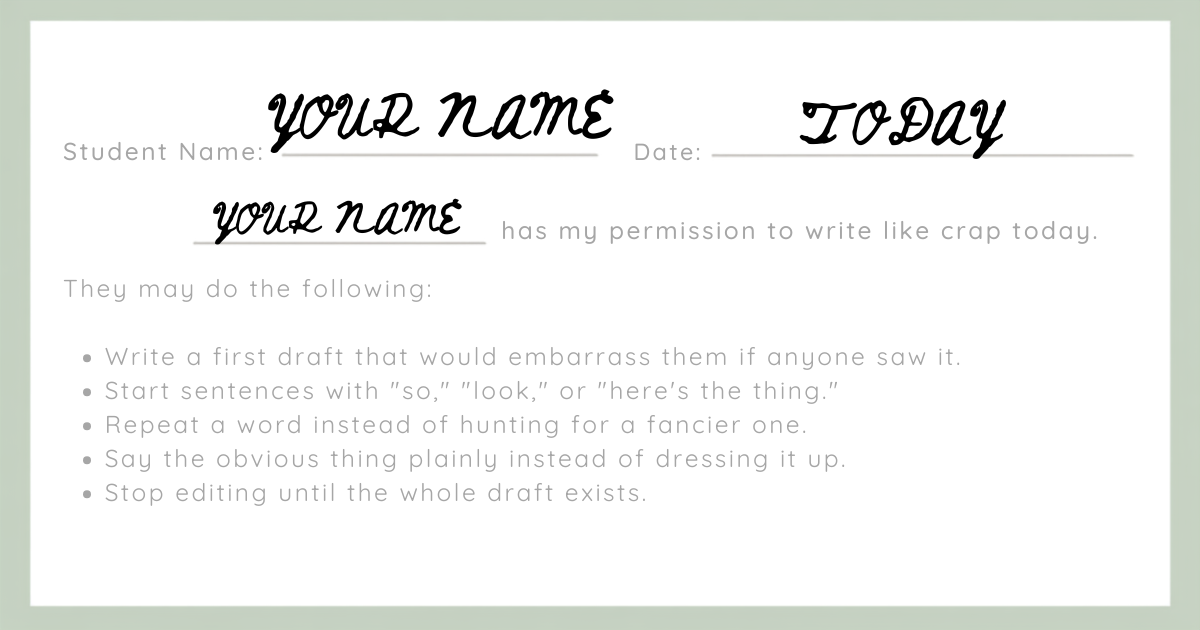
BUT, let me give you a virtual permission slip: You’re allowed to write like you talk. You’re allowed to start a sentence with “so” or “look” or “here’s the thing.” You’re allowed to write a rough draft that would embarrass you if anyone saw it, because nobody is going to see it. That’s what a rough draft is for.
A few things that actually help, since permission alone doesn’t fill a blank page.
Say it before you write it. Open a voice memo and explain your point to a friend who isn’t in your industry. Transcribe it. You’ll have rougher sentences and a much clearer point than if you’d started by typing.
Separate writing from editing. Write the whole thing badly first. Don’t fix a sentence until the draft is done. Editing while you draft is why every paragraph takes ten minutes and still feels wrong.
Steal your own words. The best line in your next post is probably something you already said out loud to a client, a friend, or in a text message. Go find it instead of inventing something new.
Here’s the part I say the most. The fantasy that good writing is supposed to feel easy is the thing costing you the most time. It doesn’t feel easy for anyone. Not for the writers you admire, not for the ones who’ve been doing it for twenty years. It just looks that way from the outside, because you only see the finished version.
You’re not bad at this. You’re comparing your rough draft to someone else’s final one. Stop doing that, and the page gets a lot less scary.